
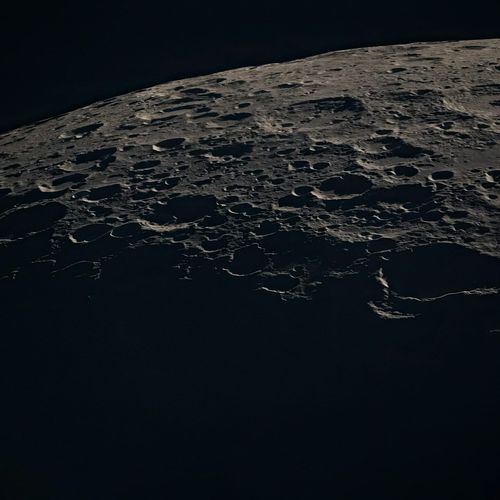
Researchers can reuse one pre-trained system for each new lunar mapping task instead of building a separate model for every geologic feature.
IBM and NASA have released the NASA-IBM Lunar Foundation Model as open-source software, meant to help researchers pick out craters, ice and volcanic terrain across decades of lunar data. It is a free download on Hugging Face, with its full codebase on GitHub, and it joins Prithvi, IBM’s line of open science models, which until now covered weather, the Sun and the Earth’s surface.
Against SwinV2-B, a Microsoft-trained vision model often used as a yardstick for image analysis, the lunar model cut errors in pinpointing areas likely to hold ice by up to 22%, and on half the training data it did nearly 19% better at finding craters. IBM’s announcement adds a 3% gain on Irregular Mare Patches, a young class of volcanic formation, reached with less fine-tuning. NASA puts the result less sharply: the model matched or beat strong baselines on every task tested, with its clear advantage in estimating how stable ice is near the poles.
NASA needs better maps of subsurface ice and of safe landing sites before it can keep people on the Moon for any length of time, and IBM says ice below the surface could supply a base with water and oxygen. That ice is thought to lie in the permanently shadowed regions near the poles, which are among the hardest places on the Moon to observe.
IBM and NASA also published the dataset the model learned from, which they call the first unified, machine-learning-ready record of the Moon. It stacks more than 30 spatially aligned layers gathered by nine instruments across four missions, among them NASA’s Lunar Reconnaissance Orbiter, its GRAIL gravity mapper and Japan’s SELENE/Kaguya. In all it runs to about two million image tiles, the sharpest at one meter per pixel. The Reconnaissance Orbiter alone has been sending back data for 17 years and has covered most of the surface in detail.
The imagery IBM used to test the model was kept out of that training set. On August 5 it gave the model a picture of the spot where a SpaceX Falcon 9 rocket had hit the Moon; the new impact lay almost on top of an older crater, and the model still tagged it as freshly made.