
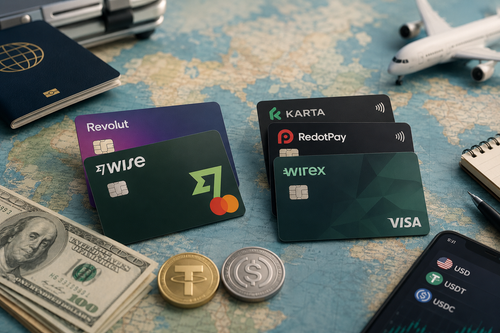
Getting a card while living abroad does not always require opening a local bank account. The best route depends mainly on how you receive and store money.
- Holding fiat currencies: compare multi-currency services such as Wise and Revolut.
- Holding stablecoins or crypto: compare card products such as Karta, RedotPay and Wirex.
Matching the card to the money you already use helps avoid unnecessary conversions, withdrawals and transfer fees.
Disclosure: This article may contain referral links. The publisher may receive a reward when someone registers through them, at no additional cost to the reader.
Important: Fees, availability and product terms vary by country and may change. Check the latest information before applying or transferring funds.
Understanding the two routes
A fiat multi-currency card lets you holding currencies such as USD, EUR or GBP and spending them directly or after conversion.
A crypto card usually connects card payments to stablecoins or other digital assets. When paying, the provider converts the required amount into the transaction currency. These routes solve different problems.
Using a fiat card usually makes more sense when receiving a salary, client payment or bank transfer. Using a crypto card may be simpler when money is already held in USDT, USDC or another supported asset. Buying crypto only to fund a card can add more cost than it removes.
Comparing fiat cards
Choosing Wise
Wise is suited to users wanting straightforward international transfers and currency conversion.
Holding the payment currency before spending can reduce costs. Converting another balance involves a separate fee, but the rate and fee are normally shown before confirming the exchange.
Choosing Revolut
Revolut may suit users wanting a broader financial app with virtual cards, budgeting tools and several plan levels.
The free plan can be competitive when staying within its exchange and ATM allowances. Going beyond those limits may add fair-usage or withdrawal fees.
When fiat cards make more sense
Consider Wise, Revolut or another fiat provider when:
- receiving money through a bank;
- needing local account details;
- holding savings in fiat;
- avoiding crypto;
- or prioritising lower conversion costs.
Comparing crypto cards
Crypto cards can shorten the route from holding digital assets to making everyday payments. Instead of selling crypto, withdrawing fiat to a bank and funding another card, the user can fund or connect a crypto balance directly. The trade-off is dealing with conversion fees, custody arrangements and regional restrictions.
Karta: funding stablecoins across several networks
Karta is aimed at users already holding USDT or USDC.
According to the supplied product information, it supports Tron, Ethereum, BNB Smart Chain, Polygon, Arbitrum, Optimism, Base and Solana. This can reduce the need to bridge stablecoins to a specific network before funding the card.
Its virtual card costs approximately 5 USDT, making it relatively accessible compared with the listed virtual-card price from RedotPay. Karta is also described as using a self-custody model, although users should review how wallet access, recovery and card settlement work.
The main limitations are clear:
- funding is currently crypto-only;
- USD purchases carry a 1.5% fee;
- non-USD spending costs approximately 2.5–3%;
- the physical card starts at approximately 100 USDT.
Karta is therefore more relevant for stablecoin holders wanting a virtual card than for users receiving all income through traditional banks.
RedotPay: supporting more crypto assets
RedotPay supports a broader selection of digital assets, including major cryptocurrencies and stablecoins.
Its conventional mobile-app experience may feel more familiar to users who prefer managing balances, card settings and payments outside Telegram.
The virtual card costs approximately $10, while the physical card is significantly more expensive. Conversion, cross-currency and certain merchant-category fees can also affect the total cost of spending.
RedotPay may suit users prioritising asset support and app-based management. Users should still review which balances are custodial and how funds are held before depositing large amounts.
Wirex: combining fiat, crypto and rewards
Wirex combines crypto features with fiat balances and card payments.
It may appeal to users wanting to manage both types of money through one platform. Wirex also offers a crypto rewards programme, although reward rates depend on factors such as the account level, region and programme conditions.
Card issuance may be free in supported regions, but delivery, conversion and ATM conditions vary. Advertised foreign-exchange benefits should also be considered alongside the actual conversion rate shown in the app.
Wirex may be more suitable for users wanting a wider financial platform rather than a card focused mainly on stablecoins.
Choosing between Karta, RedotPay and Wirex
When each card may suit you
Karta
- already holding USDT or USDC;
- using one of its supported networks;
- wanting a relatively low-cost virtual card;
- preferring its self-custody positioning;
- and being comfortable using Telegram.
RedotPay
- holding several types of crypto;
- wanting a conventional mobile application;
- accepting a custodial card structure;
- and valuing broader asset support.
Wirex
- managing both fiat and crypto;
- wanting rewards;
- preferring a broader financial platform;
- and being prepared to compare plans and programme conditions.
Final comparison
The simplest card is usually the one requiring the fewest conversions.
- Holding fiat: Wise or Revolut will often be cheaper and easier.
- Holding USDT or USDC across several networks: Karta may offer a practical funding route.
- Holding a wider range of crypto assets: RedotPay may be more flexible.
- Wanting fiat, crypto and rewards together: Wirex may offer the broader package.
Karta does not need to be the cheapest option to be relevant. Its advantage is narrower: supporting USDT and USDC across several networks while offering a relatively inexpensive virtual card and a self-custody-oriented model.
RedotPay competes through broader crypto support. Wirex competes through combining crypto, fiat and rewards.
Choosing the right option means looking at the full route from receiving money to spending it, including every cost along the way.
By the way, if Karta fits your needs, you can sign up through my referral link and receive any referral bonus currently offered by Karta: https://karta.social/d7123497cb
FAQ
Can an expat get a card without a local bank account?
Yes. Multi-currency and crypto card providers may offer alternatives, depending on the country.
Are crypto cards cheaper than fiat cards?
Usually not for fiat users. They make more sense when funds are already held in crypto or stablecoins.
Are crypto cards suitable for everyday purchases?
They can be used for groceries, transport, subscriptions and other routine payments wherever the card network is accepted. Fees and regional availability still depend on the provider.
What can be used to fund crypto cards?
Karta supports USDT and USDC, while RedotPay and Wirex support a broader range of assets.
Which card has the lowest fees?
It depends on the funding asset, payment currency, conversion fees and region.
Should crypto cards be used for savings?
They are generally better suited to everyday spending than long-term storage.
This article is for general information and does not provide financial, legal or tax advice. Card products, crypto assets and cross-border payments involve risk. Check current fees, eligibility and terms before registering.