
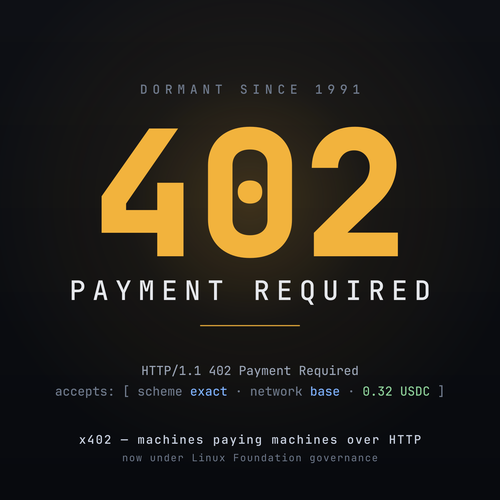
A 40-member foundation now governs Coinbase's protocol. CoinDesk reported about $24 million processed across 75 million payments in the past 30 days, most under a dollar.
The Linux Foundation announced Tuesday that the x402 Foundation is now operating under its formal governance, completing Coinbase's handoff of the protocol it originally built to a 40-member body, CoinDesk reported.
According to CoinDesk's report of the announcement, the foundation's member list spans the payments and technology industries. Card networks Visa, Mastercard and American Express sit alongside processors Stripe, Adyen and Fiserv; commerce and cloud companies Shopify, Google, Amazon Web Services and Cloudflare; and crypto firms Ripple, Circle and MoonPay, plus the Solana and Stellar foundations.
The protocol puts the web's long-reserved HTTP "402 Payment Required" status code to use. Under x402, a client can pay a server directly with small stablecoin transfers, typically USDC, without an account or any prior relationship between the two parties. The design lets software pay software without a person approving each transaction.
CoinDesk's report says the code had sat unused for roughly three decades. When the web's core communication protocols were written, 402 was reserved for payments, but conventional card-processing fees made fractional-cent charges impractical. The web instead monetised through advertising, subscriptions and API keys. That left the payment-status code as a placeholder rather than a usable part of routine web communication. x402 pairs the dormant status code with stablecoin settlement, targeting small automated payments that earlier payment rails could not economically support.
CoinDesk reported measurable activity behind the specification. Over the past 30 days, x402 processed about 75 million transactions worth roughly $24 million. Payments averaged about 32 cents and mostly landed under a dollar — the range the protocol is designed to serve for machine-to-machine commerce.
Even so, that throughput remains a sliver of what traditional payment networks move.