
Fusion plasma can go unstable faster than any person can react. Princeton has handed the controls to machine-learning models, inside safety limits people still set.
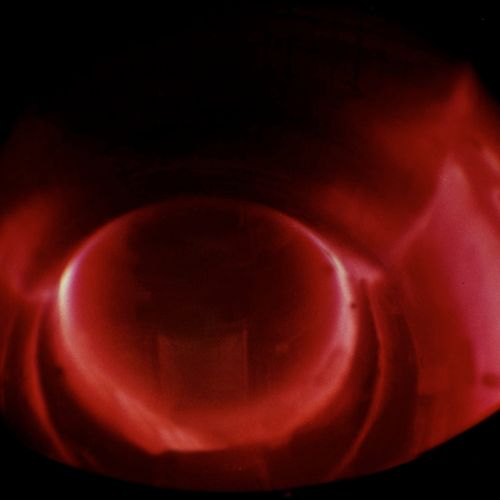
Machine-learning models ran the plasma in five experiments on DIII-D, the US Department of Energy’s tokamak in San Diego — a machine that holds a gas in magnetic fields until its atoms fuse, the reaction that powers the sun. The framework, called PACMAN, was built at the Princeton Plasma Physics Laboratory with Princeton University; its design and first results are published in the journal Nuclear Fusion.
The simulations physicists normally use take days or months, useless in an experiment lasting minutes where disturbances grow over milliseconds. A focused human operator reacts in seconds; PACMAN completes a cycle in about 20 milliseconds, fifty times a second, for the length of the run.
It works as an assembly line: the machine’s live temperature, density and magnetic readings go in; AI models predict what the plasma is about to do; controllers turn that into commands such as raising a heating beam’s power; a final stage settles disagreements and enforces hard safety limits.
In the five runs a model trained by reinforcement learning took full command of the heating systems, others held the plasma’s density and rotation at set targets, and one saw a tearing mode — an instability conventional controllers cannot detect until it is already under way — coming about 200 milliseconds ahead, which let the plasma be reshaped so it never formed.
It also steered all six of the machine’s microwave heating beams at once, retargeting their mirrors and power in real time. “There was no algorithm to find that optimal solution before,” said co-lead author Hiro Farre Kaga.
Humans still set the goals, and the framework holds the machine to its limits whatever a model proposes. Every run so far is on DIII-D, but the parts are modular: that, its authors argue, is what “turns AI plasma control from a series of one-off demonstrations into infrastructure the whole fusion community can build on,” said Egemen Kolemen, an associate professor of mechanical and aerospace engineering at Princeton.