
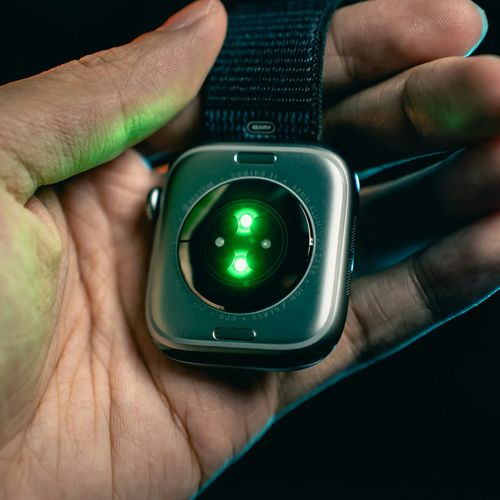
Pretrained on a trillion minutes of Fitbit and Pixel Watch data from five million people, its learned representations outperform hand-crafted supervised baselines — but stop short of clinical diagnosis.
Google Research has introduced SensorFM, a foundation model that builds one reusable profile of how the body works and behaves, read straight from wearable sensor streams, rather than training a separate model for each health outcome. The blog post announcing it, dated July 9, 2026, is credited to senior research scientist Xin Liu and staff research scientist Daniel McDuff.
The scale behind those results is unusual. SensorFM was pretrained on more than one trillion minutes of unlabeled sensor data drawn from five million consented participants across more than 100 countries. The readings came from over 20 different Fitbit and Pixel Watch device models. By the researchers' account, no wearable dataset this large or this varied has been used to train such a model before.
Concretely, the model reads 34 one-minute aggregate features derived from five sensor modalities over a full day: optical heart-rate monitoring (PPG), accelerometry, electrodermal or skin-conductance activity, skin temperature, and barometric altitude.
It learns without labels by reconstructing deliberately masked segments of that sensor stream. The masking scheme, called Adaptive and Inherited Masking (AIM), builds on the earlier LSM-2 method and treats genuinely missing readings and deliberately hidden values as equivalent, so the model can learn from the fragmentary, gap-riddled streams that real wearables produce.
Scaling model size and data together paid off. On the largest training set, the biggest variant, SensorFM-B, cut reconstruction error 31% versus the smallest, lifted downstream classification by an average of 9% in AUC and regression by an average of 21% in Pearson correlation, and came out ahead on 33 of the 35 tasks against the smaller variants.
That 34-of-35 headline result — SensorFM's simple task-specific heads beating supervised baselines built from hand-crafted wearable features — was measured on held-out ground. Evaluation used 13,985 participants who appeared nowhere in pretraining, drawn from three separate Institutional Review Board-approved prospective studies, across 35 tasks spanning cardiovascular health, metabolic health, mental health, sleep, demographics and lifestyle.
The limits are firm. SensorFM was trained and tested only on Fitbit and Pixel Watch data, a constraint the researchers acknowledge, according to The Decoder. And while health summaries built on the model's predictions showed no statistically significant overall difference from those built on actual known health values, the researchers stress this does not mean SensorFM can replace clinical measurements or diagnoses.