

AI won't be fully centralized — that much is already clear. In one form or another, open models will coexist with frontier closed ones. But the shape of that coexistence, and how wide the gap between the two becomes, depends largely on access to energy and compute: the physical infrastructure that DePIN has spent two market cycles building out, in distributed form.
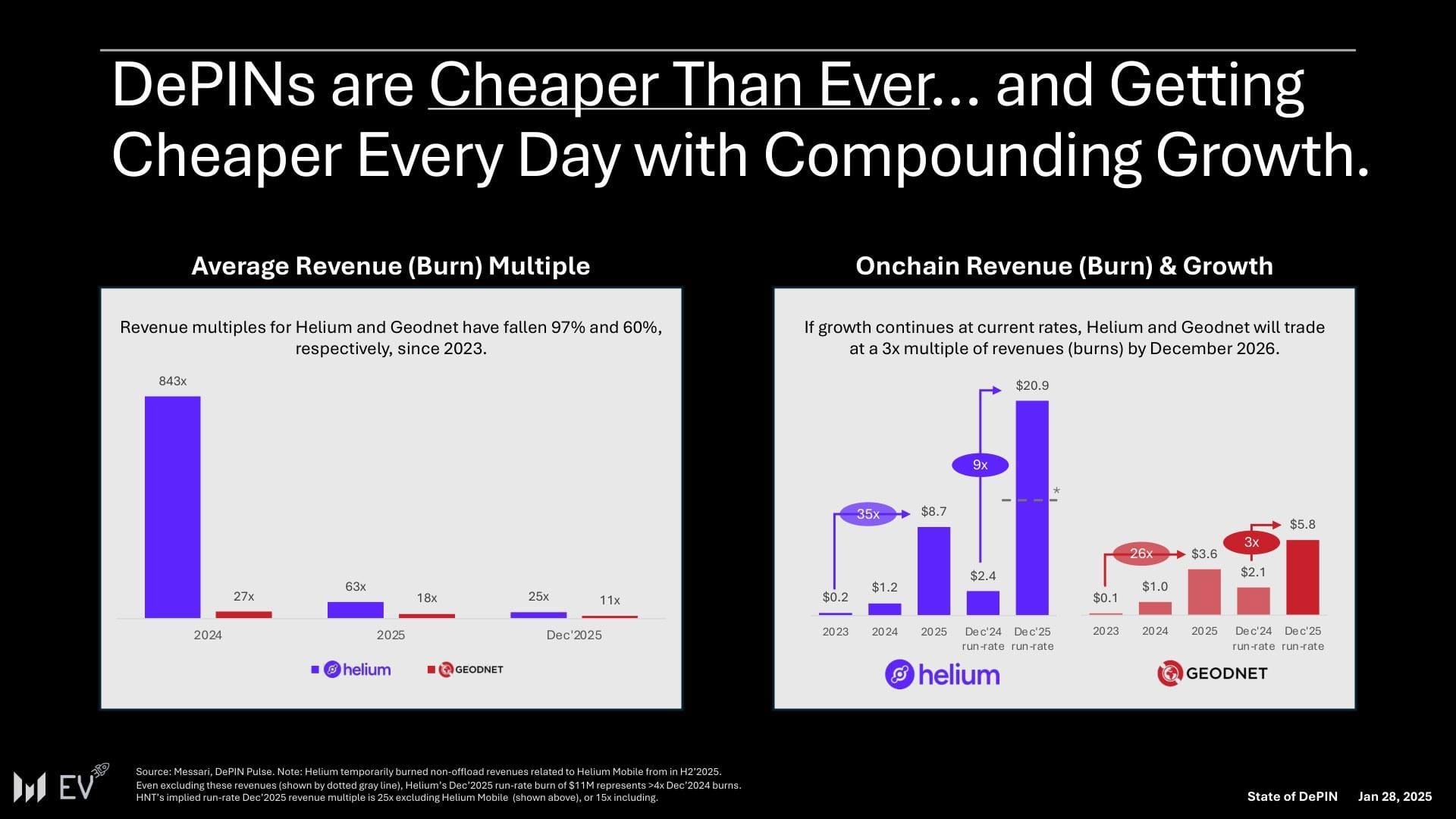
The first wave of DePIN (Decentralized Physical Infrastructure Networks), launched on the promise of reshaping infrastructure markets, has been through a couple of overheated altcoin cycles and seems to have fallen off the radar — the leaders of that wave now trade at 94–99% below their peaks. On-chain revenue points the other way.
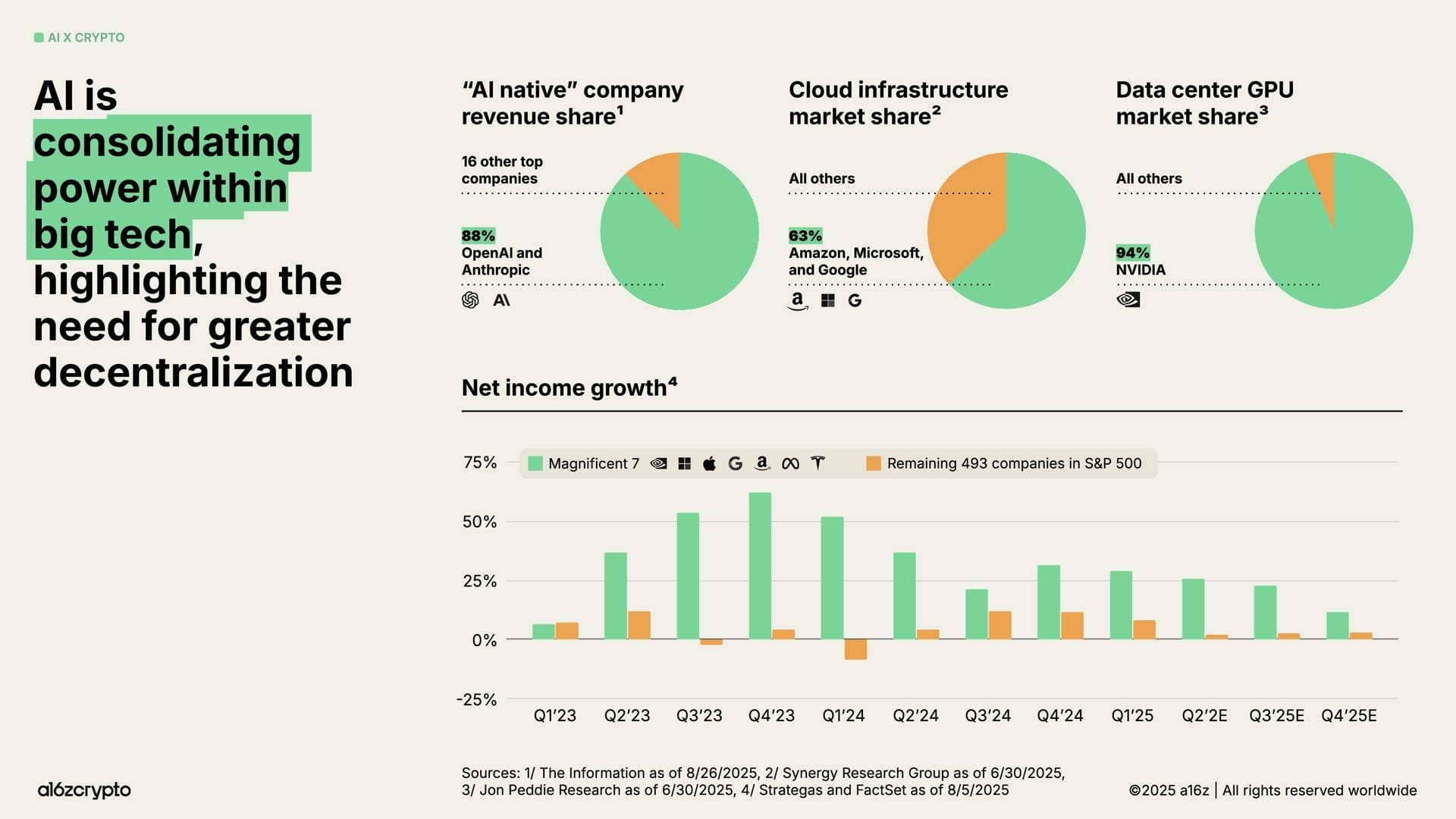
Source: a16z's State of Crypto 2025 report
By the start of 2026, according to the Messari report, the sector had grown to a $10 billion market cap and generated $72 million in on-chain revenue over 2025, led by bandwidth, compute, energy, and sensor networks. And a16z, in its industry report State of Crypto 2025, placed DePIN in the top three categories with the strongest product-market fit signals, alongside stablecoins and tokenized real-world assets.
Investment capital flowing into the category through 2025, against flat token prices, also turned out to be the strongest in DePIN's history. Yet most investors' view of the sector still lags behind the operational reality the data shows; that's the key takeaway from Messari's analysts.
Source: Messari's State of DePIN 2025 Report
In 2021, the sector was pre-revenue, with valuations soaring on multiples north of 1000× and growth riding on retail speculation. In 2025, it's revenue-generating, with multiples of 10–25× and growth driven by real utility and cost advantage. Token prices don't reflect that shift yet.
What DePIN is — and who builds it
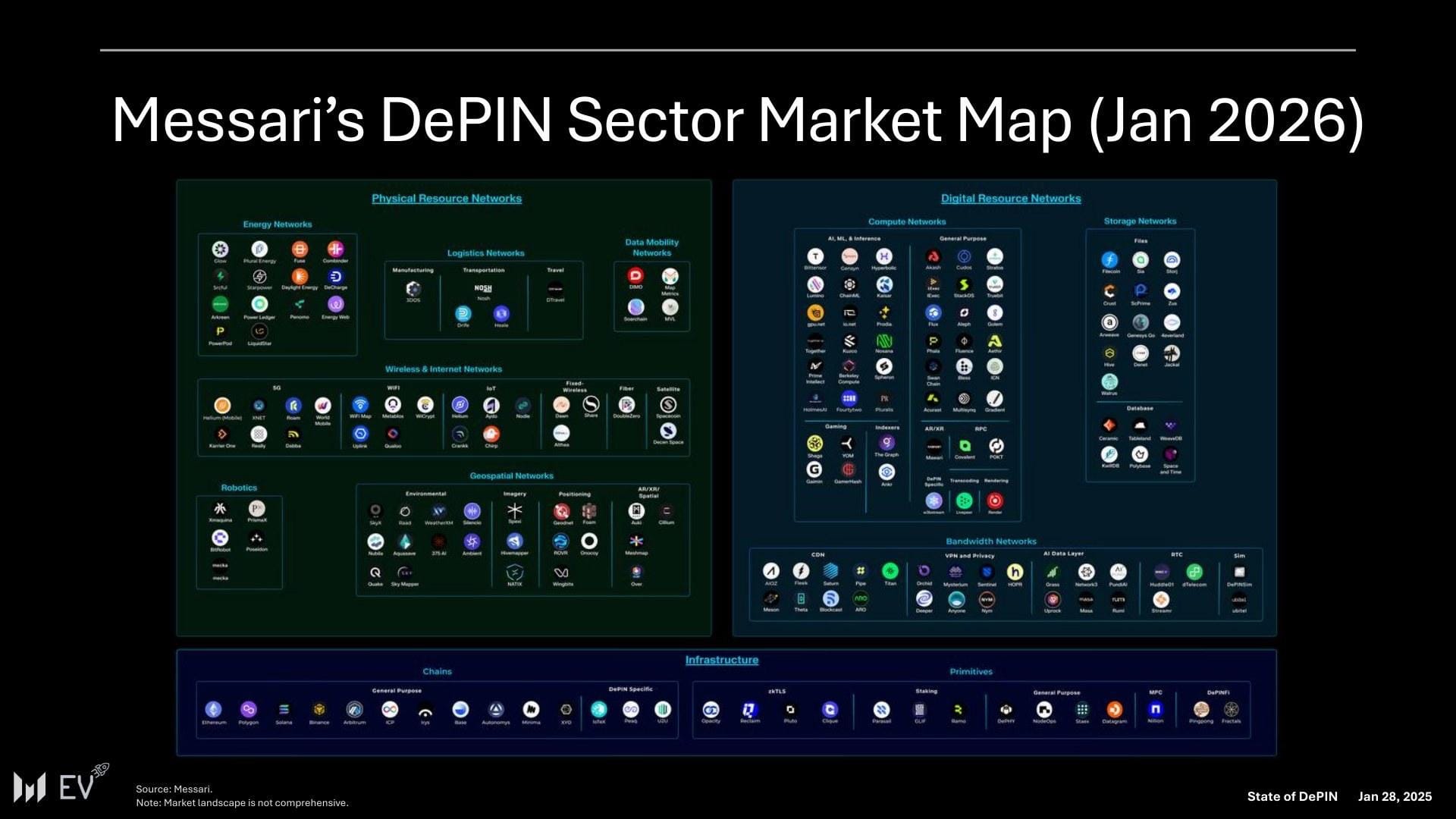
DePIN uses token incentives to build out physical infrastructure through the efforts of thousands of independent participants. A hotspot in an apartment window extends wireless coverage; a dashcam on a car's dashboard collects fresh map data along regular routes; an idle GPU in a data center or home rig contributes compute for AI workloads. The list goes on.
Source: Messari's State of DePIN 2025 Report
This model redistributes the cost of building infrastructure. Instead of a single company doing centralized planning and heavy-capex construction of telecom towers, fiber and data centers, the network grows piece by piece: participants buy their own hardware, and the network pays them back in tokens, fees, or a mix of both. A blockchain protocol coordinates everything — it logs participation, verifies useful work, and connects suppliers with buyers. End users pay for whatever the network provides (connectivity, compute, geolocation, storage, rendering) on the same rails.
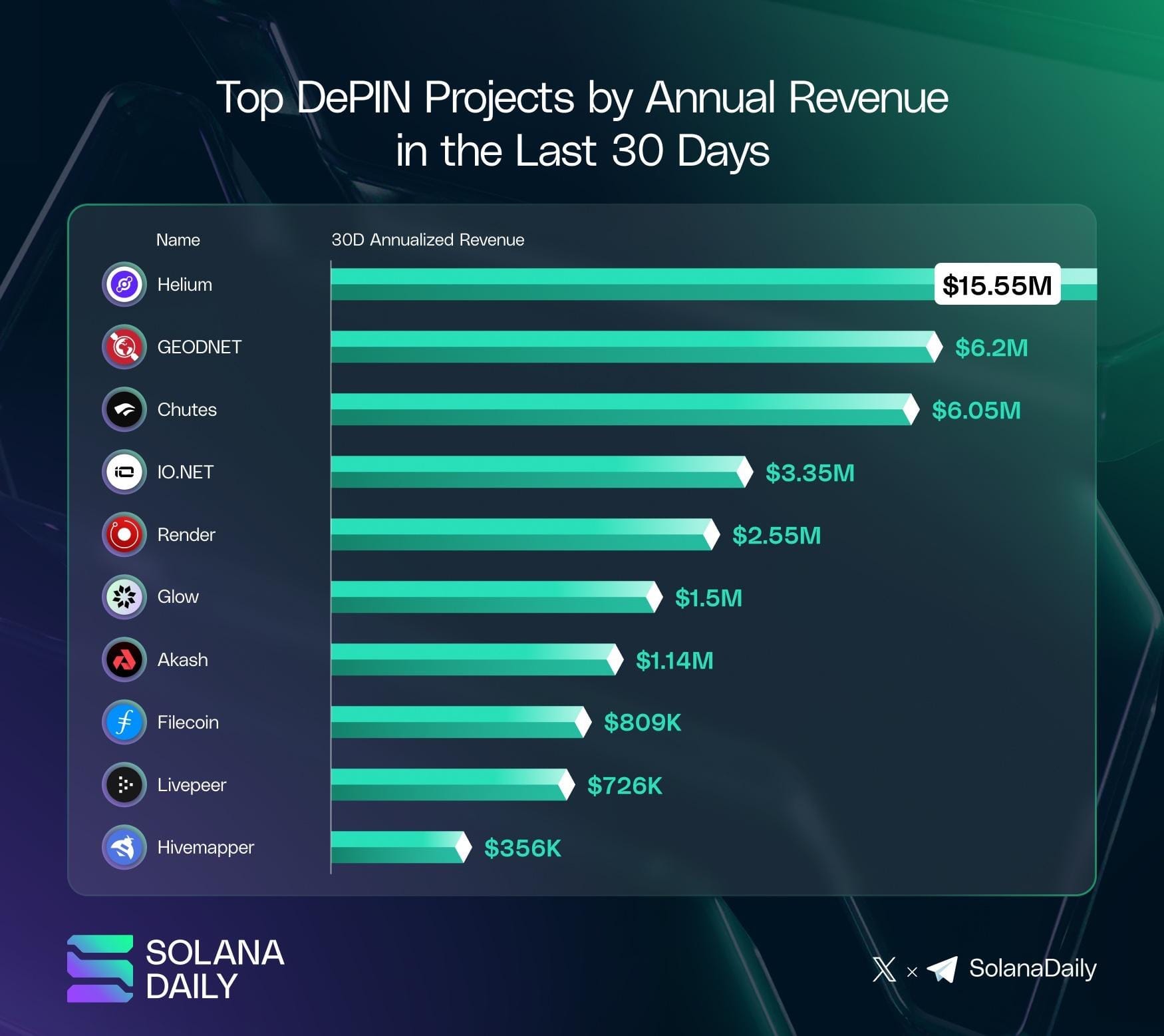
A recognizable set of networks now embodies this model. Helium runs wireless and IoT, with hundreds of thousands of hotspots in undercovered regions by 2026. Hivemapper handles mapping, assembling an open map of the world from dashcam footage in geographies where Google Maps updates lag by years. Akash, io.net, and Render sell GPU-hours to AI startups and research institutions. Powerledger runs peer-to-peer energy, with electricity trading pilots in Indian megacities. Filecoin covers storage, GEODNET handles precision GPS, and dozens of other verticals operate alongside them.
Source: @solana_daily on X, Apr 23, 2026
Of these, the strongest demand right now is for decentralized compute — that's where the AI bottleneck and the clearest economic case meet.
AI compute, the demand engine
The gap between GPU supply and demand for AI workloads is the most important structural driver behind decentralized compute networks in 2026.
Training a single large LLM takes tens of thousands of top-tier GPUs over weeks, and that capacity is tightly concentrated: around 60% of hyperscale data-center capacity belongs to Amazon, Microsoft, and Google (Synergy Research Group, Q1 2026), and most of it is already locked up in multi-year contracts. For anyone outside the frontier-lab race, compute becomes both a pricing problem and an access problem.
It's no longer just an industry issue. AI computing has become geopolitical infrastructure faster than governments have learned to handle it. The GPU today, much like the steam engine or machine tools, and conveyor belts in their time, is a technology whose presence buys a vast economic lead — and one no serious competitor can afford to be without.
This is where DePIN networks come in, as one possible answer to the bottleneck. Instead of building new data centers, they aggregate hardware that already exists but is underused, scattered across thousands of independent owners: gaming rigs, mid-tier colocations, and idle GPUs in crypto infrastructure.
Bitcoin has already proven this pattern — both in scale (~26 GW of capacity, more than all hyperscalers combined) and in pace. Open, meritocratic competition squeezed 300,000× efficiency gains out of ASICs over 16 years, against roughly 100× for GPUs over the same period — a 3,000× advantage for the open, competitive lineage. Now the same sites, energy contracts, and operator expertise are being partially repurposed for AI workloads: some of that capacity goes into centralized AI/HPC contracts with hyperscalers (tens of billions in early 2026 alone), while part of the GPU fleet plugs into decentralized compute marketplaces.
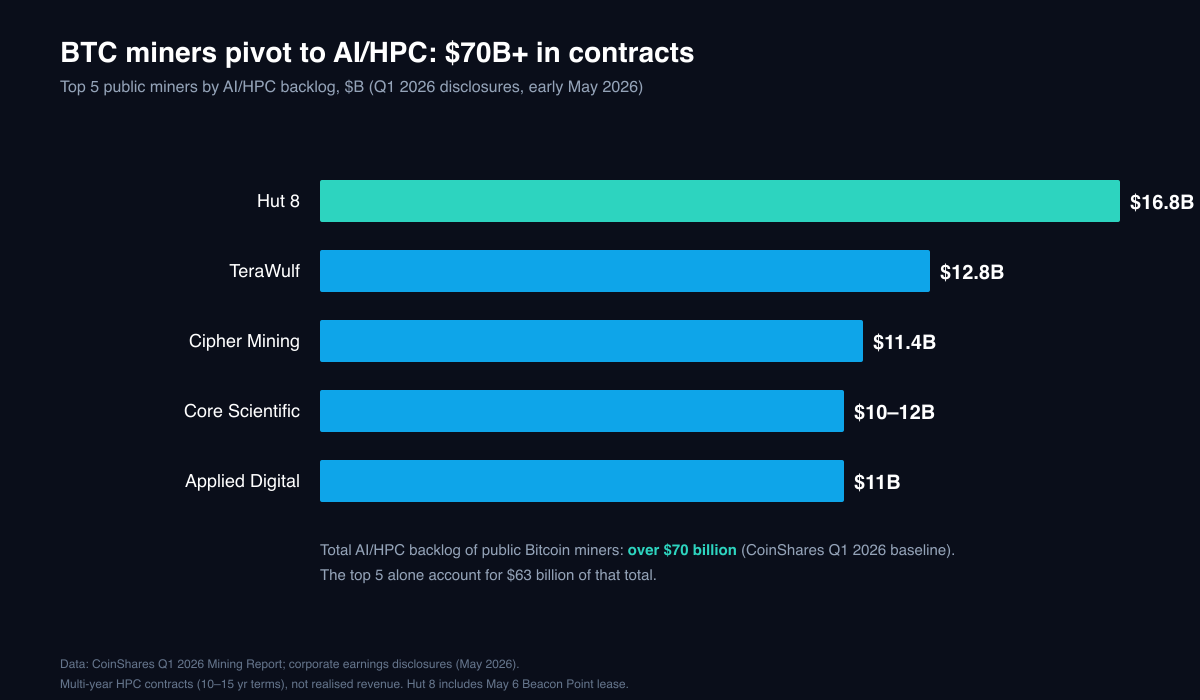
Data: CoinShares, Bitcoin Mining Report — Q1 2026; Q1 2026 corporate earnings disclosures, including Hut 8 Q1 2026 release, May 6, 2026. Figures are contracted multi-year HPC commitments (10–15-year terms), not realized revenue.
Over the last three years, a slew of decentralized compute networks have emerged, each with its own positioning. Render Network handles rendering and AI inference. Akash Network handles general cloud and CPU compute on Cosmos. Gensyn (backed by a16z) operates a decentralized training network. Nosana focuses specifically on GPU inference at the edge, targeting latency-sensitive AI applications.
Per benchmarks aggregated by Yellow.com and DefiLlama in Q1 2026, decentralized GPU networks can deliver cost savings of 60–90% compared to on-demand pricing from hyperscalers like AWS and Azure for training and inference workloads. On Akash Network, compute auctions often close 80–90% below comparable AWS listing prices. GPU inference on Render Network came in roughly 70% below Azure Machine Learning compute in third-party tests.
These pricing advantages are already translating into real revenue: the decentralized GPU sector, in aggregate, was generating an estimated $200 million in annualized protocol revenue at the start of 2026 (on-chain data from DeFiLlama and Dune Analytics).
In fairness, reliability and support in DePIN are still less mature than in centralized clouds. On top of that, there are technical challenges tied to the heterogeneity of the hardware fleet, ranging from an RTX 3090 in a gaming PC to an A100 in a data center.
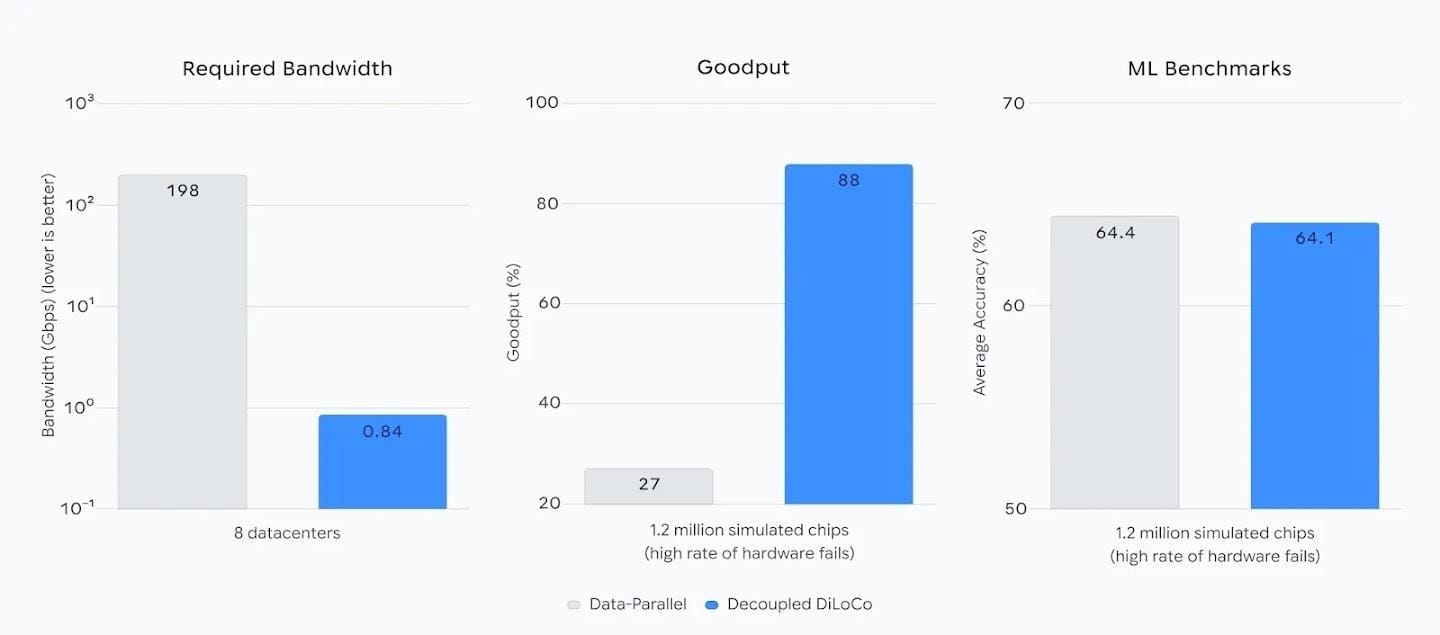
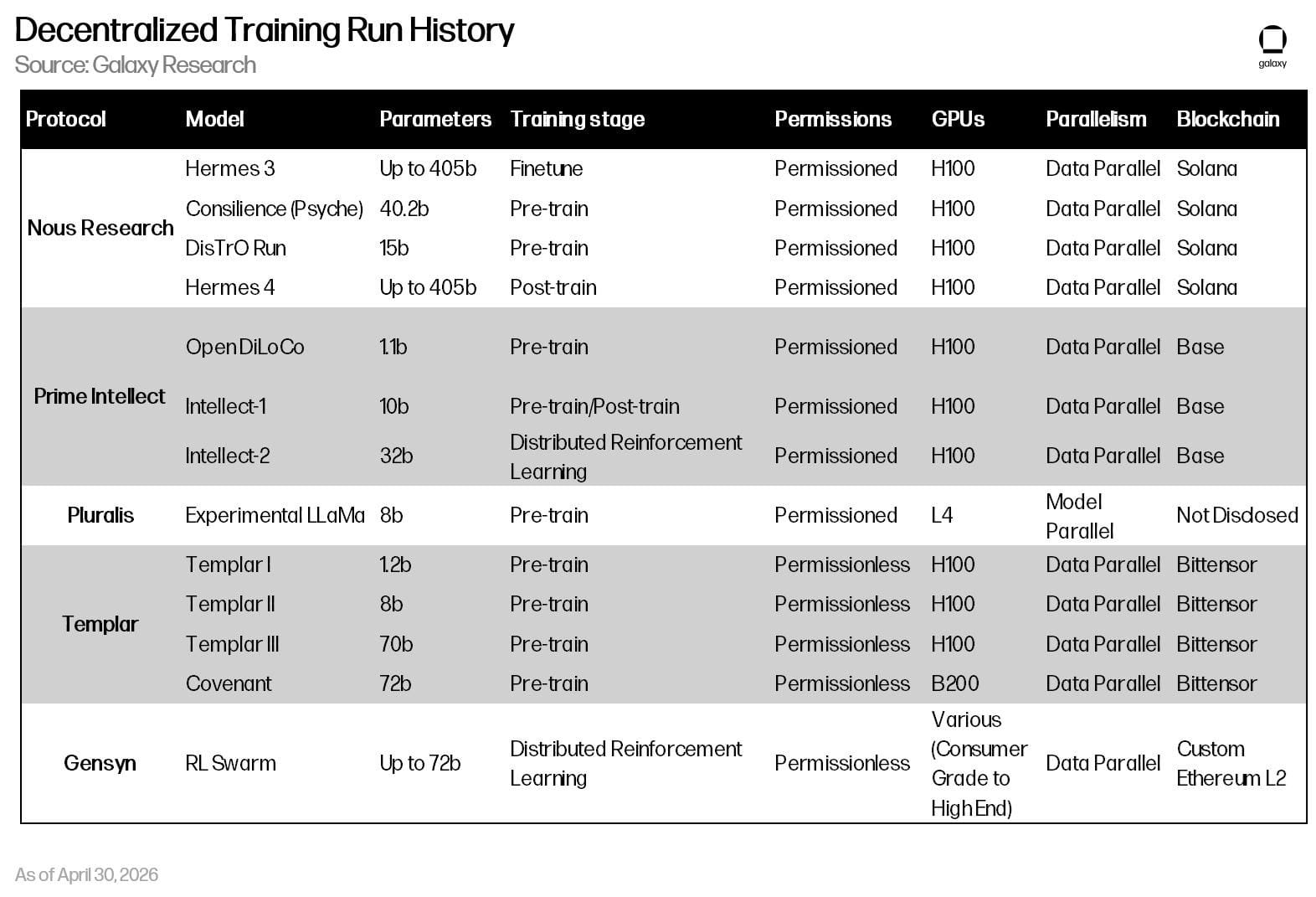
Architecturally, though, the direction is being validated by the hyperscalers themselves. In April 2026, Google DeepMind published Decoupled DiLoCo and trained a 12-billion-parameter model across four US regions on ordinary WAN connectivity, 20× faster than synchronous training. The Bittensor subnet Templar used the same approach to train a 72-billion-parameter model on 70+ distributed GPUs over the public internet.
Source: Google DeepMind, Decoupled DiLoCo: efficient training across multiple datacenters, Apr 23, 2026
And for cost-sensitive AI startups, the trade-off is tilting toward decentralized compute, while the market itself is growing faster than any incumbent can serve. The same economics apply in academia, with research budgets shrinking globally: decentralized frameworks offer a meaningful cost advantage over equivalent university HPC time while delivering comparable throughput for certain workload types.
Source: Galaxy Research, Weekly Top Stories — May 1, 2026
InfraFi and the capital layer
For most of DePIN's history, networks financed infrastructure buildout through a speculative premium on utility tokens. That math worked through the bull markets of 2020–2021, but by 2025, the premium had waned across most altcoins, and the sector needed a new model.
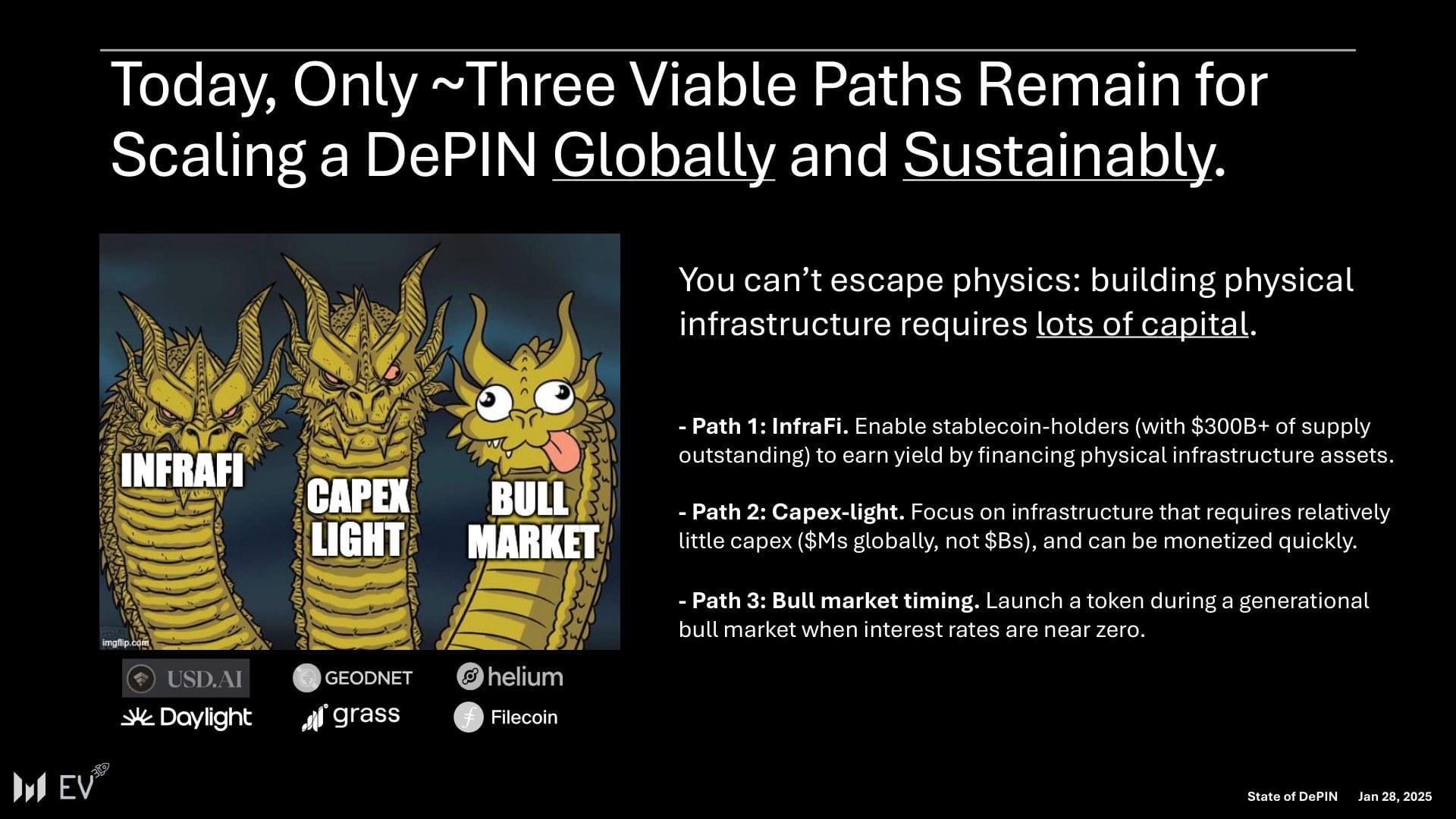
In parallel, another capital pool gained prominence in crypto: stablecoins. In April 2026, the stablecoin market crossed $320B, and some of that capital is actively chasing yield.
InfraFi connects this demand to DePIN's physical infrastructure. The crowd can now contribute to the sector not only with hardware, but also with capital. Stablecoin holders deposit funds into a specialized vault, whose capital is used to purchase and deploy GPU fleets, solar panels, batteries, and bandwidth networks. Infrastructure revenue flows back into the vault, and depositors withdraw stablecoins along with a share of the yield.
Source: Messari & EV3, State of DePIN 2025, Feb 4, 2026 — slide 7
Over the course of a year, the model rolled out across compute and energy with USDai and Daylight as pioneers; bandwidth is the next category being onboarded. USDai in compute, the largest of the compute vaults by deposits, accumulated around $340M earmarked for GPU purchases.
And beyond DePIN itself, the largest players in stablecoin infrastructure have started routing capital into these vehicles. Sky authorized $2.5B of its own USDS stablecoin (roughly 19% of total collateral) for deployment through the Obex Accelerator incubator, and the same USDai was part of Obex's first $1B batch (March 2026).
The model is nascent, and the risks are obvious: duration mismatch (physical infrastructure cannot be liquidated during a redemption rush), credit risk (hardware breaks, goes missing), and principal-agent problems between underwriters and depositors.
Even so, the next step is already more ambitious. The same rails are being used to acquire existing legacy businesses and migrate them onto crypto infrastructure. That's the play of Inversion Capital ($26.5M seed led by Dragonfly Capital), which frames its thesis as "DePIN does for infrastructure what SaaS did for software."
What's at stake
With the AI compute bottleneck, DePIN has found a clear product-market fit, and as of today, the sector's top operators by revenue have a working proof of concept for the model, while the rest still have only narratives.
The market hasn't priced this shift in yet. The top DePINs by revenue, with multi-year >100% YoY growth and a cost advantage over hyperscalers, trade at multiples that imply the sector has little chance of surviving at all, let alone succeeding.
Frontier centralized AI models will continue to coexist with open ones; that much is clear. The question is how wide and how decisive the gap in quality and accessibility will turn out to be. If the open branch does not reach comparable pricing and operational maturity, this "hybrid" will take shape as a regulated monopoly with an open storefront.
Open technologies prevent any single player from cornering the field. The structures that stand in the way of such capture, especially when they grow organically, are the best antidote to it. And they're being laid down today, in the open infrastructure being built around AI compute, bandwidth, and energy.
Physical infrastructure is the key obstacle keeping AI from becoming a public good. And over a couple of market cycles, DePIN has laid the groundwork for a decentralized solution: first through hardware, then through operations, and now through capital, opening up a way for the crowd to participate directly in this buildout, in its own interest.