
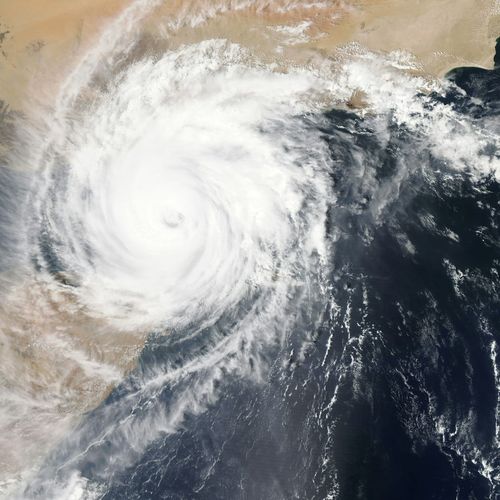
Five days out, it gave Hurricane Melissa's Category 5 landfall in Jamaica an 80 percent chance, while other models were still split between that and a weak storm heading for Haiti.
WeatherNext, the AI weather model built by Google DeepMind and Google Research, forecasts cyclones with accuracy never achieved before, according to a study published Thursday in Nature. The gain averages a day over the models already in service: what WeatherNext says three days ahead is as reliable as what those models could say two days ahead.
A one-day improvement in hurricane forecast lead time would historically have taken about a decade of work, the researchers behind the model say. Even a few extra hours can change a hurricane response, the director of the US National Hurricane Center told Wired: getting people out, pre-positioning supplies and shifting resources into place all run against the clock, and a bad call there carries heavy consequences — which is why he puts so much value on the additional day of forecast accuracy.
The live case was Hurricane Melissa, which developed over the Caribbean Sea in October 2025. It was the first time the National Hurricane Center was able to predict a storm would reach Category 5 strength while it was still only a Category 1. Melissa proved devastating, setting off floods and landslides across Jamaica, but the early prediction helped forecasters warn communities in its path sooner so they could better prepare.
Hurricanes are unusually hard to forecast because they play out across several spatial scales at once, the study co-author who leads tropical cyclone work at the Cooperative Institute for Research in the Atmosphere told Wired. Working out where a storm will travel takes planetary-scale weather information — where cold fronts sit, which way prevailing winds are blowing. Predicting how strong it will get requires much smaller-scale data on local atmospheric and ocean conditions, which the co-author says global models simply do not provide. Earlier AI systems, the co-author says, did a good job of working out where a storm was headed but were no good at all at judging how strong it would be.
Cyclone-specific data is scarce while general weather data is plentiful, a research scientist at Google DeepMind and one of the study's lead authors told Wired, so the model was trained to handle both ordinary weather forecasting and cyclone prediction well. Why it produces forecasts this accurate is something the DeepMind team cannot entirely explain: the atmospheric data it works from is far coarser than conventional approaches need to say how strong a storm will get — a reliance the lead author says shocked the wider research community, because it implies those inputs capture more predictive signal than had been believed. What that signal is, the researchers do not know; the lead author describes the model as a black box that nonetheless indicates to physicists that something not previously understood is happening.
Rather than a single forecast, the model produces a range of potential scenarios for how a developing storm might unfold. In 2025 it generated 50 scenarios per storm; it now generates 1,000, a volume the co-author who leads tropical cyclone work says would not be possible with the computing power traditional numerical weather models rely on.
Google DeepMind said it is releasing the WeatherNext models it ran through hurricane season as open source, so researchers can work with them and build on them. The lead author told Wired he hopes putting them in the hands of researchers everywhere turns up new understanding of the way cyclones behave.
The Hurricane Center director calls the model a valuable addition to forecasters' toolbox, and only one tool among many. Doing well over one season, or on a single storm, is no assurance that a model will come out on top the following season or with the storm after that, the director says. Human expertise remains critical, he adds, because a hurricane forecast is not just a track or an intensity number: experts are still needed to translate that data into real-world impacts, and it is those impacts that ultimately cause fatalities.