
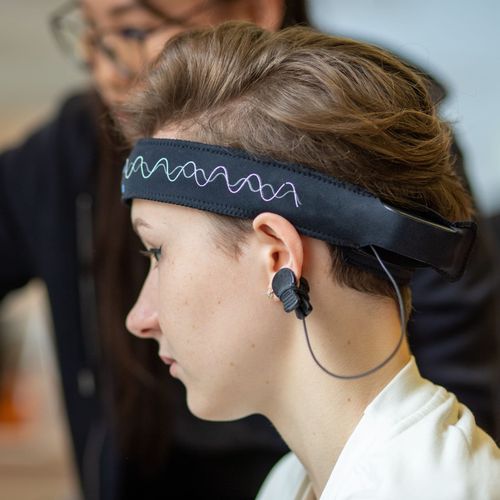
Hemispheric trained its model on 250,000 hours of brain data from 100,000 paid volunteers to read cognitive disorders from a roughly 15-minute EEG session, with a first FDA filing planned for early 2027.
Hemispheric, a startup whose co-founders include Gidi Littwin, a co-inventor of the technology behind Apple's FaceID and Vision Pro, has raised $52 million to build an AI that identifies cognitive disorders from the brain's electrical activity, without any surgery.
In the method the company describes, a patient wears a light EEG headset that records electrical activity in the brain for about 15 minutes while using an app on a tablet. A frontier model then works out how the brain is functioning from those signals, in much the way large language models extract meaning from text through statistical analysis.
The founders treat their training data as their most valuable asset: 250,000 hours of brain data gathered from 100,000 paid volunteers across Asia and in Tel Aviv and Boston, who ran game-like exercises designed to stimulate different regions of the brain.
The premise is that brain activity differs from person to person, which is why physicians have largely leaned on subjective questionnaires and behavioral observation to diagnose conditions such as depression, Alzheimer's and Parkinson's.
Hemispheric says it tried a generalized model on people carrying diagnoses of PTSD, schizophrenia and depression and drew correct conclusions about each one's brain health, a result that has not been independently verified. It has since begun a clinical trial testing whether the model can both identify and forecast Alzheimer's.
The founders plan to file their first product, aimed at PTSD research, with the FDA for clearance in early 2027, and are counting on that clearance to allow a public release later the same year. The new capital, from US and Israeli venture firms and individual backers including early Uber investor Howard Morgan, is earmarked for building ties with governments, health care bodies and drug makers, adding staff in the US, and pursuing regulatory clearance.
For now, the claim of correct results rests on Hemispheric's own account, and the first product still has to clear the FDA.