
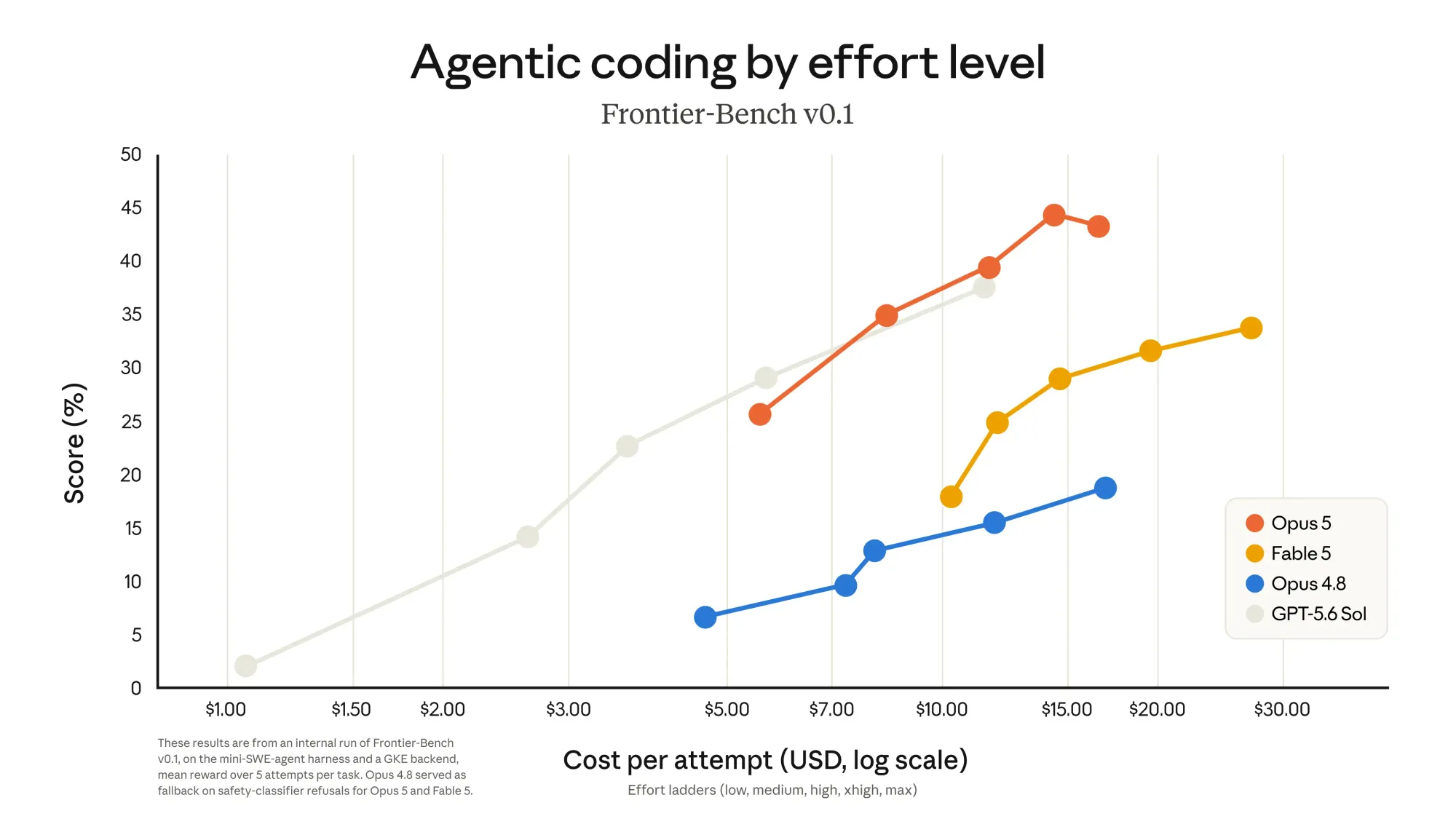
By Anthropic's own figures it more than doubles Opus 4.8's agentic-coding score — 43.3 percent against 18.7 — and passes the flagship Fable 5's 33.7, at the same price as the model it replaces and half what Fable 5 costs.
Anthropic released Claude Opus 5 on Friday, putting it to use the same day across all its platforms, from Claude Code to its website. The model is priced at $5 per million input tokens and $25 per million output tokens — the same as the Opus 4.8 it replaces, and half what the flagship Fable 5 costs. According to Anthropic's announcement, Opus 5 comes near Fable 5's frontier intelligence at that lower price.
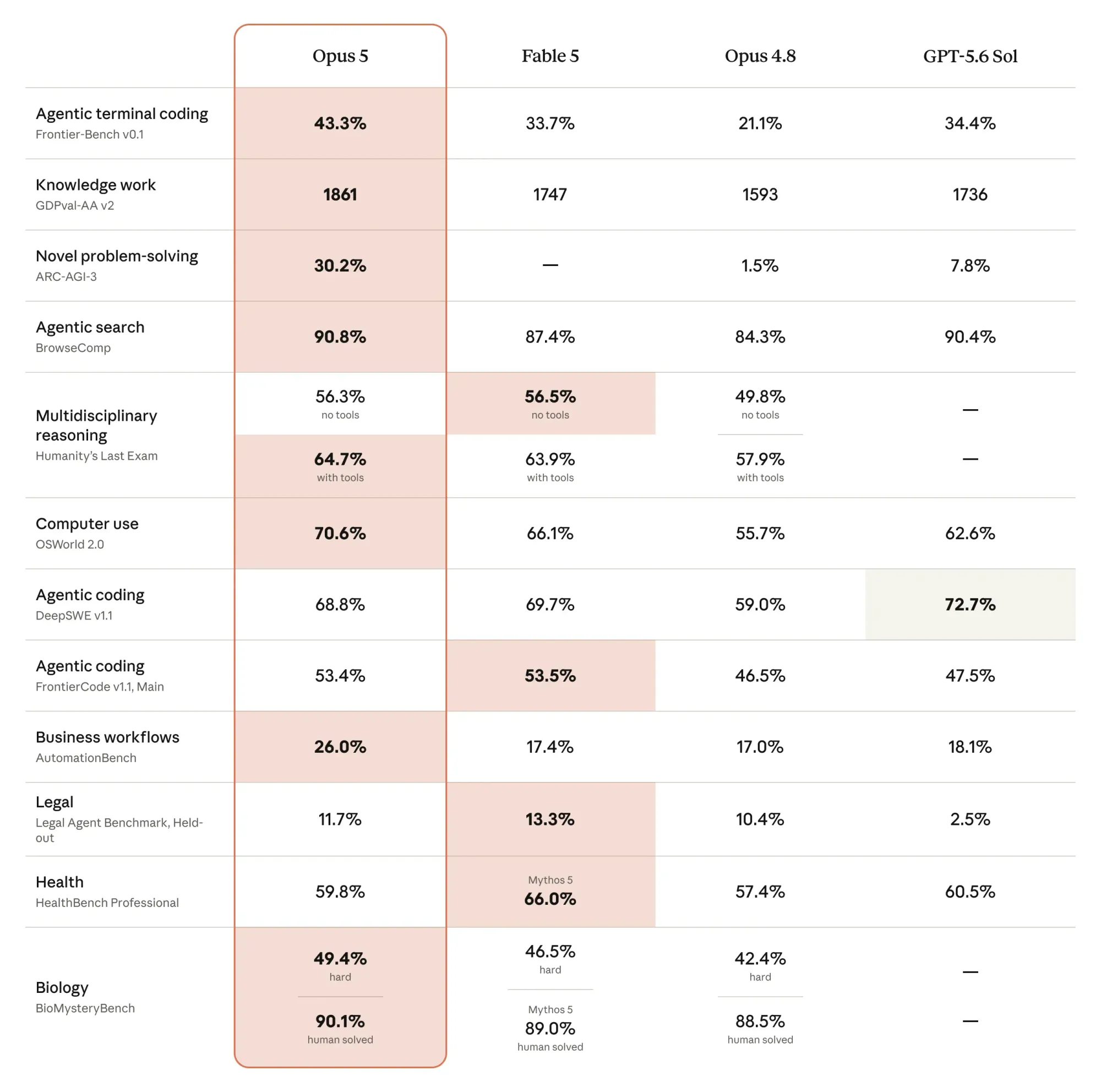
Opus 5 steps in as the default on Claude Max, Anthropic's top consumer tier, and the most capable option for Claude Pro subscribers. The company pitches it as an everyday workhorse that outscores Fable 5 on programming and knowledge-work tests. A spokesperson told VentureBeat the lineup is now split by task: Opus 5 for day-to-day complex work checked after it finishes, Fable 5 for the longest autonomous projects, Sonnet 5 where high volume makes per-call speed and cost decisive, and Haiku 4.5 for subagents and instant replies.
Anthropic's pitch turns on performance per dollar rather than peak capability. The new adjustable 'effort' setting is where that trade becomes explicit — customers dial intelligence down for greater speed and fewer tokens, or up when a task warrants it. A separate fast mode runs about 2.5 times quicker at double the standard rate. Harvey, which builds AI for the legal profession, said Opus 5 matched what Opus 4.8 produced in its top reasoning setting while generating 26 percent fewer tokens on average.
The release lands as enterprise buyers turn budget-minded, warier of paying for costly models without a clear return, and as cheaper rivals squeeze on price — among them Microsoft, Amazon, Google and several Chinese startups. Developers had complained that Fable 5 devoured tokens, draining allowances and running up bills. OpenAI leaned on similar token-efficiency claims for its recent GPT-5.6. Dianne Penn, Anthropic's research product-management lead, told CNBC that businesses want value, and that a lower-priced model that can't match comparable quality isn't genuinely helpful.
Still, the company isn't billing Opus 5 as its smartest model. Fable 5 keeps that title and stays Anthropic's recommendation for the most extended, self-directed jobs that have to hold together across many steps over hours or days; Opus 5's wins, a representative told VentureBeat, come on well-defined tasks aimed at a set result. The company also concedes the model still trails Mythos 5 on offensive cybersecurity and biology research, and it urges customers to try both against a workload like their own.