
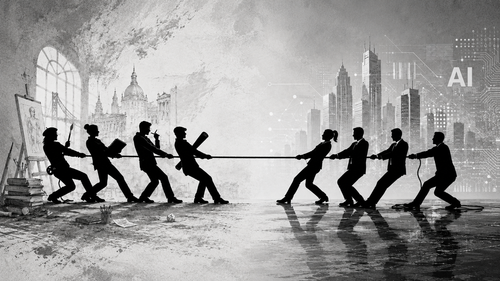
AI ownership is becoming one of the most pressing legal and strategic questions in tech. As models like Seedance 2.0 generate Hollywood-level cinematics and platforms like Cursor write enterprise-grade products through "vibe coding," a fundamental question emerges: if AI can rival professional-level output, who actually owns what it produces?
The uncomfortable reality is that you can "own" parts of an AI-driven workflow while never owning the model itself - and depending on your jurisdiction, you may not own the output in the copyright sense even if a contract says you do.
The Rented Intelligence Problem
When you access an AI via API, you receive access plus a stream of outputs whose legal status changes depending on where you are and how you use them.
There are three distinct questions at play - and the answers don't always agree:
- Contract: what rights does the provider actually grant you?
- Law: what does your jurisdiction recognize as protectable authorship?
- Control: what can you safely commercialize, defend, and keep from being disrupted by a platform change?
Who Owns AI Output? The Contract Layer
The contract layer is the cleanest because it's written down - but every vendor's terms differ.
Under OpenAI's Terms of Use, users retain ownership rights in their inputs. Under their Services Agreement for businesses, the customer "retains all ownership rights" in input. On output rights, OpenAI's Terms state you "own the Output to the extent permitted by applicable law." Anthropic's commercial terms on Bedrock state that "Customer owns all Outputs" within that agreement's framework.
The qualifier - "to the extent permitted by applicable law" - is the entire story. A contract can grant you rights against the provider. It cannot rewrite copyright law.
AI Copyright Law: Human Authorship vs. Computer-Generated Works
This is where AI ownership law becomes genuinely complex - and jurisdiction-dependent.
United States: According to the U.S. Copyright Office's registration guidance, material generated by a machine that lacks human authorship is not registrable. The analysis turns on the degree of human contribution. The key question is what counts as "enough" human authorship - and how you prove it when the creative process includes a model.
United Kingdom: The UK Copyright, Designs and Patents Act 1988, Section 9(3) takes a structurally different approach. For a "computer-generated" work, "the author shall be taken to be the person by whom the arrangements necessary for the creation of the work are undertaken." The setup crew gets the credit.
Japan: According to Japan's Agency for Cultural Affairs guidance on AI and copyright, materials autonomously generated by AI are not considered copyrighted works because they are not "creatively produced expressions" of thoughts or sentiments. No human creativity, no copyright.
The US wants a human fingerprint. The UK hands rights to whoever arranged the process. Japan applies the strictest standard. The winner in any dispute is whoever can demonstrate the most human authorship.
Models Relying on Models: The Quiet Dependency Chain
A growing share of AI products are not a single model - they are a dependency graph: one vendor for generation, another for moderation, another for speech, another for embeddings.
As AI agents dominate this segment, the risk splits across three dimensions:
- Rights stacking: you are only as free as the most restrictive license or term in the chain
- Output laundering: if Model B transforms Model A's output, you may still carry constraints from A's terms or from copyright's human-authorship rules
- Market concentration: dependency chains quietly centralize power in a few model providers, even when the product looks decentralized
Economic and Legal Consequences of the Gray Zone
The U.S. Copyright Office ties copyrightability to human authorship, which leaves purely machine-generated material in a legal gray zone - and that gray zone gets exploited.
Rights-holders have already challenged generative AI on both training use and on outputs that function as substitutes, including Getty Images v. Stability AI and The New York Times v. OpenAI and Microsoft.
Regulation adds a second axis: not "who owns," but "who must disclose." Article 50 of the EU AI Act introduces transparency duties around synthetic content and deepfakes, shifting significant compliance work onto deployers and platforms.
AI Model Ownership as a New Asset Class
If you don't own the model, you may still:
- Own your inputs
- Hold contractual rights to outputs
- Own the human-authored layer you add on top
But owning the model - or holding durable rights to run it under a license you can live with - is qualitatively different from all of the above.
That is why AI model ownership is emerging as a new kind of asset class - one the markets will increasingly price like infrastructure. The question is no longer just "can I use this AI." It is "what do I actually control, what can I defend, and what happens if the platform changes the terms tomorrow."