
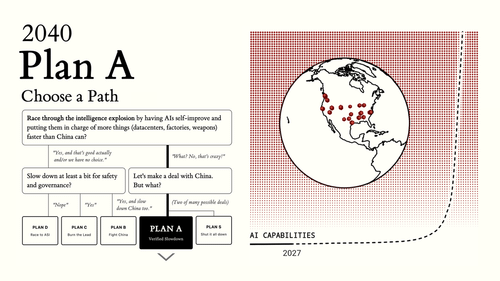
The AI Futures Project's 'Plan A' prescribes an international transparency deal and 'mutually assured compute destruction' — and calls it a recommendation, not a forecast.
The AI Futures Project, the forecasting team behind the grim AI 2027 report, has published a follow-up it calls Plan A, or AI 2040 — a positive alternative to the extinction-or-power-grab endings it once laid out for a race to smarter-than-human AI. Six researchers share the byline. Daniel Kokotajlo and Eli Lifland appear alongside Ryan Greenblatt and Thomas Larsen, with Brendan Halstead and Romeo Dean completing the list.
At its center is an international deal to hold superintelligence off until 2040, built on total transparency of AI research and a regime the authors dub 'mutually assured compute destruction.' The aim is to have dozens of companies across several countries scale slowly and safely in the open, rather than racing one another in secret.
The authors ground the proposal in three claims. First, they think AI companies will probably manage to build smarter-than-human systems sometime in the next one to ten years. Second, they argue the industry has talked itself into believing that control of such systems can be sorted out on the fly, and so has no adequate plan — a posture they call terrible and potentially lethal. Third, they contend that even a race that is won and whose AIs are successfully aligned would still hand a small group, or a single person, effective command of the world's only army of superintelligences.
Crucially, the authors present Plan A as a recommendation rather than a prediction — a vehicle to communicate and stress-test policy ideas, not the future they expect to unfold. The recommended course is not what they think will actually happen; only the scenario's downstream effects are offered as genuine forecasts. Daniel Kokotajlo, quoted on LessWrong (AI), said the team still thinks it worth recommending what would actually be good, even while expecting their audience probably won't act on it.
Axios's Ashley Gold, in remarks carried on LessWrong (AI), boiled the plan down to a call to slow everything down — a shorthand the authors would regard as an oversimplification. Skeptics push harder: if superintelligence isn't imminent, the threat isn't real, and there is no reason to pay steep costs to brake development that is already moving slowly.
Journalist Timothy B. Lee, quoted on LessWrong (AI), called the AI 2040 scenario implausible and pointed to a fundamental 'epistemic chasm' — between those who believe superintelligence implies near-omnipotence and those, like him, who do not.
Cover: infographic from “AI 2040: Plan A” by the AI Futures Project.